Intelligent Robotics in Bavaria: from research to application
Robotics connects mechanics, sensors, and software. With Physical AI, a new generation of robots emerges, combining perception, learning, planning, and physical action to handle increasingly complex tasks independently. This includes humanoid robots. It opens new applications in manufacturing, logistics, and agriculture, in clinics and care.
Bavaria combines scientific excellence with industrial practice for this. Technical University of Munich bundles its robotics research in the Munich Institute of Robotics and Machine Intelligence (MIRMI) and coordinates the nationwide Robotics Institute Germany. In Oberpfaffenhofen, the German Aerospace Center develops robots for space, production, and assistance. Further hotspots are in Nuremberg and Erlangen, Würzburg and Schweinfurt, Augsburg, Bayreuth, Regensburg, and Cham. Manufacturers, suppliers, and start-ups bring the results into application.
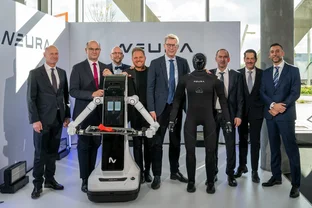
In the Bavarian AI ecosystem, intelligent robotics is one of the four Hubs of the Hightech Agenda Bavaria. Since 2026, 21 partners from science and industry have been working together in the Competence Network Humanoid Robotics Bavaria . The closer humans and robots work together, the more important Safety, reliability, and understandable behavior become. Bavaria's particular strength lies in internationally leading research on learning robots, perception, and safe human-robot interaction. These competencies provide the foundation to further develop Physical AI and reliably use robots in everyday life.
Loading...
Fields of application of robotics

Medicine and care
Robots assist in operations, rehabilitation, and care. In Garmisch-Partenkirchen, TUM is developing the assistant robot GARMI for independent living in old age. In Erlangen, Fraunhofer IIS, University Hospital, and FAU are working to transfer the movement knowledge of caregivers to a humanoid robot. Systems for OR, intensive care, and care come from Brainlab, Devanthro, navel robotics, and Reactive Robotics.
Logistics and autonomous systems
Mobile robots transport materials, pick goods, and work in fields, construction sites, and green areas. In Bavarian plants like BMW in Regensburg or MAN in Nuremberg, autonomous transport robots are used. Technology for automated logistics is developed by, among others, Filics, Grenzebach, idealworks, Magazino, SAFELOG, and WITRON. Angsa Robotics, Kewazo, and Paltech show applications in municipalities, construction, and agriculture.

Industry and production
Robots take over precise or physically demanding work and learn new tasks faster with AI. In the KI.FABRIK in Munich, TUM trains dual-arm robots for joining tasks. Siemens has tested a humanoid robot in its own production in Erlangen. Robots and robotics solutions come from Agile Robots, KUKA, RobCo, and sewts, components from HEIDENHAIN, Schaeffler, and TQ-Systems.
Robotics
Prosthetics for the future
Interview with Prof. Cristina Piazza on her research at TU Munich

Smarter Grasping: Cristina Piazza on the Hand of the Future

Robotics
Smarter Grasping: Cristina Piazza on the Hand of the Future
Robotics
Munich robotics start-ups
Successful TUM spin-offs in the billion range
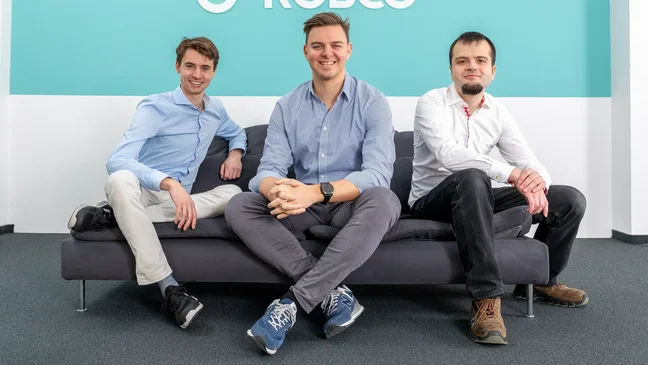
RobCo becomes Unicorn: Munich robotics start-up reaches billion-dollar valuation

TUM start-up becomes a unicorn

Robotics
RobCo becomes Unicorn: Munich robotics start-up reaches billion-dollar valuation

Robotics
TUM start-up becomes a unicorn
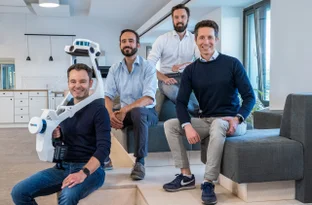
TUM RoboGym
Where robots learn
In the TUM RoboGym, teams from research and industry train new skills for practice.
Loading...

Studying in Bavaria
Studying robotics in Bavaria
Learn moreFunding & Financing
Current calls
Funding offers around the robotics area

EU funds AI and robotics for industrial remanufacturing

Horizon Europe 2027: Millions in Funding for AI in Industry
NVIDIA plans investments in two Munich AI startups
Funding for German-Korean AI and Robotics Projects

Funding & Financing
EU funds AI and robotics for industrial remanufacturing

Funding & Financing
Horizon Europe 2027: Millions in Funding for AI in Industry

Funding & Financing
NVIDIA plans investments in two Munich AI startups

Funding & Financing
Funding for German-Korean AI and Robotics Projects
Loading...




Loading...




Frequently asked questions about robotics in Bavaria
What is AI-supported robotics?
Traditional robots repeat programmed routines. AI-supported robots recognize their environment, learn from examples, and adapt to new tasks. Experts call this Physical AI or embodied AI.
Where is robotics researched in Bavaria?
In all seven administrative districts. Locations include Munich with the MIRMI of the TUM and fortiss, Oberpfaffenhofen with the DLR, Garmisch-Partenkirchen as well as Nuremberg, Erlangen, Würzburg, Schweinfurt, Augsburg, Bayreuth, Regensburg, Cham, Ingolstadt, Kempten, and Landshut.
Where can I study robotics in Bavaria?
Robotics programs are offered by, among others, the THWS in Schweinfurt (Bachelor's and Master's Robotics), the University of Applied Sciences Kempten (Bachelor Robotics, Master Automation Technology and Robotics), the Coburg University of Applied Sciences (Bachelor Automation Technology and Robotics), the Deggendorf Institute of Technology in Cham (Master Robotics), the Technical University of Ingolstadt (Bachelor Robotics and Autonomous Systems / Master Secure AI, Robotics, Autonomous Mobility), the Technical University of Nuremberg (Master Artificial Intelligence & Robotics) and the TUM (Master Robotics, Cognition, Intelligence).
How do companies enter into robotics and AI?
Funding programs are available in the Overview of AI funding. For professional exchange, there are networks like the Cluster Mechatronics & Automation and the Competence Network Humanoid Robotics Bavaria – a network of 21 partners from science and industry, organized by Bayern Innovativ. Since 2026, they have been working in three working groups on infrastructure, use cases, and regulation.
Your contacts for robotics in Bavaria
BAIOSPHERE highlights the strengths of the Bavarian AI and robotics ecosystem across facilities and regions. The Bavarian AI Council and the Bavarian AI Agency promote the exchange between science, business, start-ups, and politics and create additional connections beyond existing networks – in Bavaria, Germany, and Europe.

Prof. Dr. Angela Schoellig
TUM Professor & Director of Industry and International at MIRMI as well as a member of the Bavarian AI Council and Coordinator of the RIG.

Lydia Generotzky
Head of Science Relations
BAIOSPHERE AGENCY
+49 162 206 3172