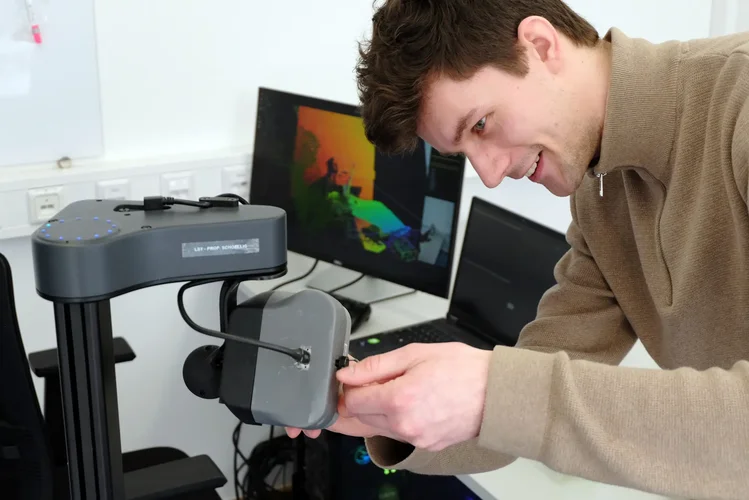
Researchers of the Technical University of Munich (TUM) have developed an innovative robot that uses image understanding specifically for concrete tasks. The mobile robot from the Learning Systems and Robotics Lab by Prof. Angela Schoellig can analyze its surroundings, create a three-dimensional model, and specifically search for objects.
The robot outwardly resembles a mobile broomstick with camera at the top. Using a camera and additional depth information, it creates a Centimeter-accurate 3D model of its environment, which is continuously updated.
AI combines image understanding and language models
The camera initially provides two-dimensional images, whose pixels additional Depth information included. This creates a spatial map of the surroundings. At the same time, a connected computer uses artificial intelligence for object recognition as well as a Language model, that analyzes relationships between objects.
For instance, the robot can recognize that a Glasses are more likely to be on a table or a windowsill. as on a stove or in the sink. This information is translated into the robot's internal "language" and represented as probabilities on the three-dimensional map of the environment.
This allows the robot specifically search for objects and reach relevant places much more efficiently – according to research findings up to 30 percent more efficient than a random search.
Learning from changes in the environment
The robot is also capable of compare old and new pictures of his surroundings. For example, if a new object is in a room, it detects this change with a Success rate of around 95 percent. These areas are then marked as particularly likely for the search.
In the long term, such technologies could autonomous robots in factories or in the care sector enable them to navigate independently in dynamic environments.
In the next step, the researchers are working on ensuring that robots also Objects behind doors or in drawers be able to find. In the future, they should interact more with their environment—by having robotic arms open cabinets and recognize how different handles or doors can be operated.