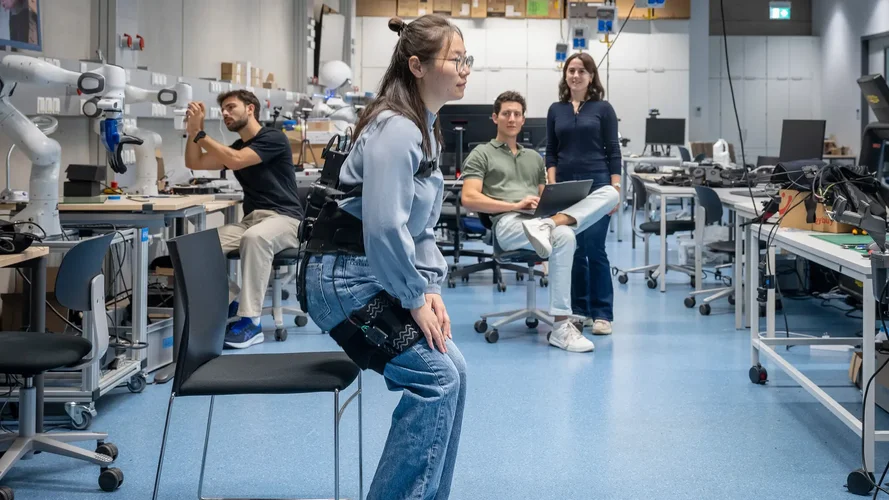
Standing up and walking consist of complex movement patterns that people usually perform largely unconsciously. For a robotic system to assist in this, it must recognize the movement and provide its additional force in sync.
A research team is working on this at the Chair of Intelligent Bio-Robotic Systems at the TUM School of Computation, Information and Technology. For the exosuit's control, machine learning is used. The algorithm was initially trained with movement data from young, healthy individuals and is to be further improved through additional usage data.
The goal is assistance that integrates as intuitively as possible into natural movement and only supports when additional force is needed.
Sensors detect movements in real time
Unlike rigid exoskeletons, the TUM system is designed as a lightweight robotic suit. The exosuit consists of two thigh straps, a hip belt, and artificial tendons connected to a small motor worn on the back. The system can be put on and taken off in a few minutes and can be worn over normal clothing.
Two sensors on the thighs continuously capture leg movements. When the control detects that the person is standing up or walking, it activates the motor. This pulls on the artificial tendons, thereby supporting the hip movement.
The combination of sensors, machine learning, and robotic actuation is intended to allow the technical assistance to automatically respond to the respective movement.
Study shows support in standing up and walking
The system was tested with ten adults aged between 69 and 85 years who had limitations of the lower extremities. With the support of the exosuit, individual participants could perform up to four additional sit-stand cycles per minute. The duration of one cycle was reduced by up to 21.9 percent.
On average, participants achieved 18 sit-stand cycles per minute, which is two more than without the corresponding support.
An effect was also observed while walking: metabolic expenditure was reduced by as much as 27.5 percent in the best case, and by 14 percent on average. This suggests that the robotic support can reduce physical exertion during everyday movements.
Assistance aims to maintain autonomy
In addition to physical relief, the research team also examined how users perceived the assistance. On a seven-point scale, the rating of the feeling of personal control was over six points.
This is relevant for the development of close-to-the-body assistive systems: the technology should support movements without giving the impression that the system is taking over control.
In the long term, the exosuit is intended to primarily support older adults in maintaining their independence. Another possible field of application is rehabilitation. The research combines AI-based motion analysis with wearable robotics, aiming to better adapt physical assistance to individual movements.