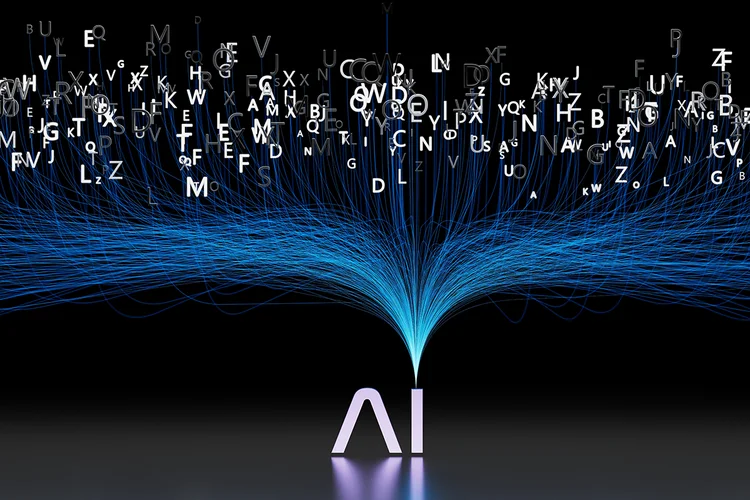
Large language models like those behind ChatGPT do not process texts directly as single letters. Instead, they first break down inputs into so-called tokens – often whole words or word parts. This process is called subword tokenization .
Tokenization enables efficient text processing, but it also brings limitations. Language models can have difficulties with tasks that require a precise understanding of individual characters, such as spelling words backward or analyzing unusual character sequences.
An alternative is byte-based language models, which process texts on a finer level. They do not rely on a fixed vocabulary of word fragments and can thus more directly capture the character structure of texts.
However, such models have so far been associated with significant challenges, particularly in terms of training effort and performance compared to established LLMs.
Byteification instead of complete retraining
An international research team led by Assistant Professor Valentin Hofmann of LMU Munich has now developed an approach to reduce these hurdles.
The new method allows for already trained language models to be converted into byte-based models, without needing to be retrained fully.
This requires less than one percent of the training effort that would normally be needed for a corresponding language model. At the same time, the performance of the original model remains largely intact.
According to the researchers, the resulting models outperform all previously published byte-based language models of comparable size.
The study was conducted in collaboration with the Allen Institute for AI, the University of Cambridge, the University of Washington, and Imperial College London.
Better understanding of individual characters
A key advantage of byteification is the improved processing of the fine structure of text.
While conventional language models, for instance, may struggle with spelling words backward, byteified models perform significantly better on such tasks.
The researchers see this as more than just an improvement in individual language tasks. Precise processing of character sequences is also relevant in scientific and technical applications.
This includes particularly program code and biological sequences, where individual characters or their exact sequence can be crucially important.
Byte-based models could therefore open up new possibilities for AI applications that go beyond the processing of natural language.
New perspectives for the development of large language models
The results show that existing LLMs do not necessarily have to be retrained from scratch to benefit from another form of text processing.
Instead, byteification could open a way to further develop powerful pre-trained models while simultaneously reducing known limitations of subword tokenization.
The researchers hope that byte-based language models could become a practical alternative to today's LLM architectures.
To support further research, the team has made the developed models, program code, and training data publicly accessible.
The work published in Nature thus provides a new approach for the efficient further development of large language models and could become particularly relevant where precise processing of individual characters and complex sequences is essential.