“A Cryptographic Perspective on Machine Learning Trustworthiness Challenges”
With Prof. Shafi Goldwasser, one of the world's leading cryptography researchers was a guest at the Munich AI Signature Lecture. At the invitation of Prof. Frauke Kreuter, the Turing Award winner came to Munich and spoke before an almost full house at the Bavarian Academy of Sciences. Another approximately 350 people followed the event via livestream.

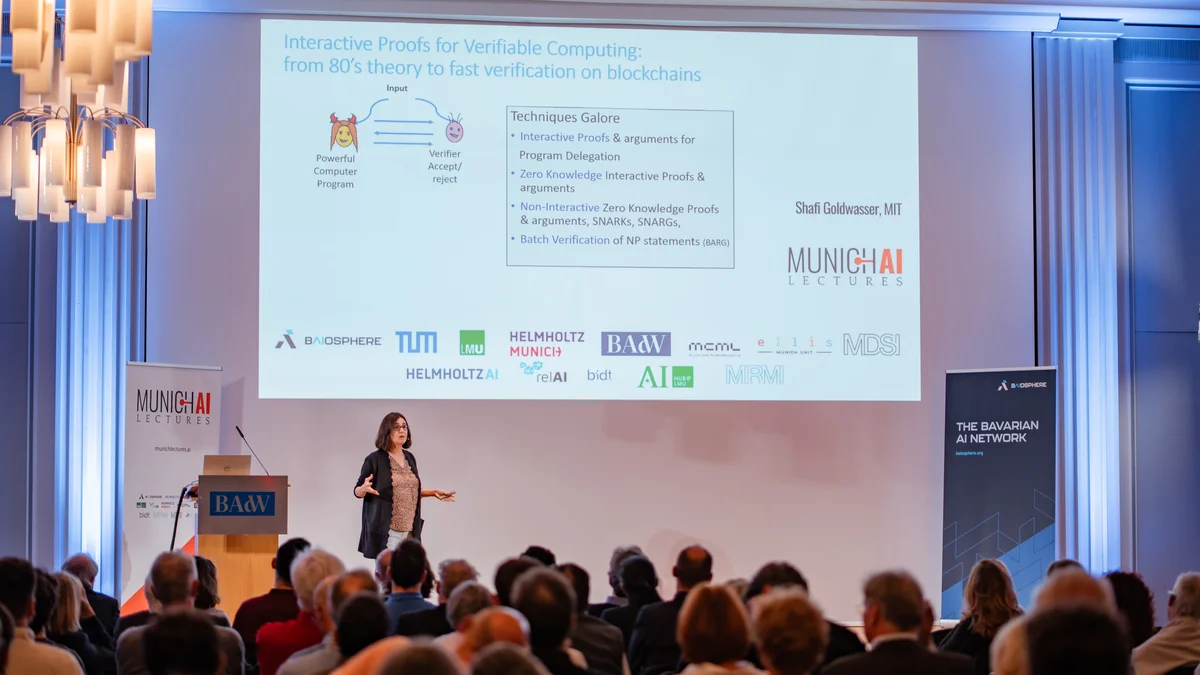



Powerful AI models can provide convincing but false answers. Good test results are therefore not enough to ensure their reliability in every individual case. Goldwasser presented the concept of Self-Proving Models . These models should not only generate an answer but also simultaneously provide verifiable proof of their correctness.
To achieve this, training methods are being researched in which AI systems learn to produce solutions with verifiable justifications. An independent auditor could then check whether the result meets the specified requirements.
Hidden Manipulations in AI Models
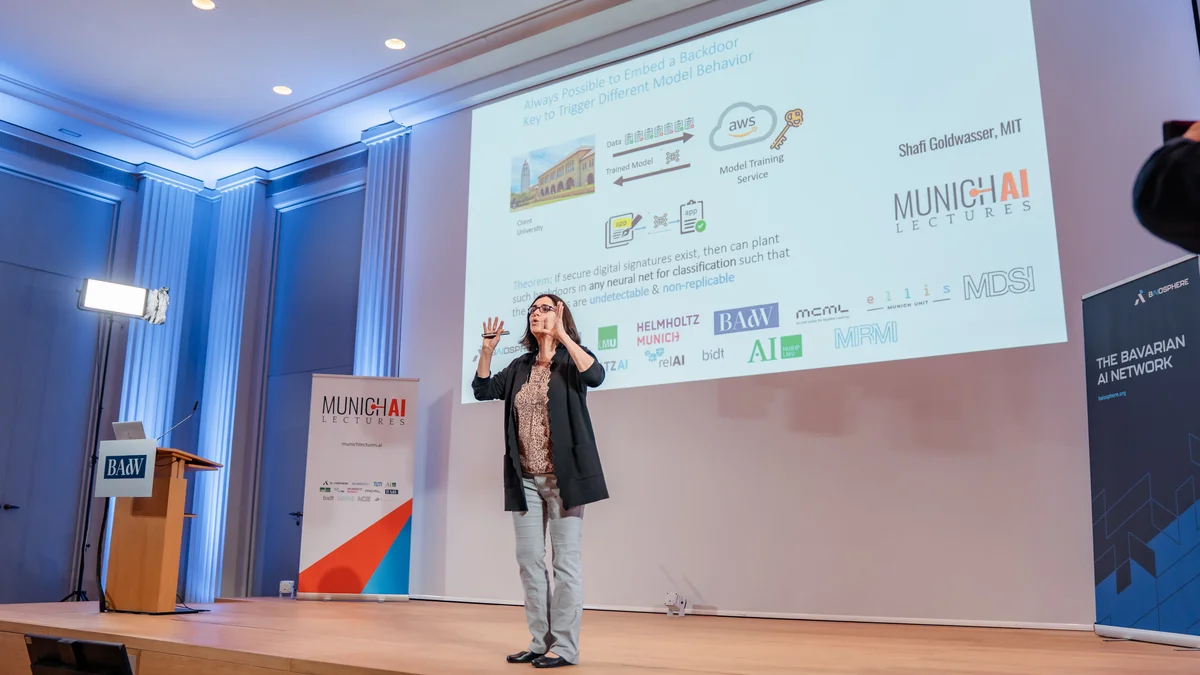
Another focus was so-called Undetectable Backdoors. These are targeted manipulations whereby an AI model produces incorrect results for certain secret inputs, while otherwise functioning inconspicuously.
Goldwasser explained that such backdoors can be practically undetectable under certain cryptographic assumptions. At the same time, she presented research approaches that can neutralize the effects of such manipulations in certain mathematical tasks – even without pinpointing the backdoor itself.
Why Security Filters Are Not Enough
Many AI systems use filters aimed at detecting and blocking dangerous requests. Goldwasser demonstrated using so-called Time-Lock Puzzles, that such pre-posed protection mechanisms have fundamental limits.
A problematic command can be encrypted so that a pre-posed security filter does not recognize it, but a more powerful AI model can later decrypt it. The conclusion is that security measures must not rely solely on external filters but must also be considered within the AI model itself. Pre-posed filters alone cannot guarantee comprehensive protection.
Mathematical Guarantees Instead of Reliance on Test Results
Goldwasser's research approach applies cryptographic methods to AI security. The goal is to precisely define security requirements and mathematically examine under what conditions they can be fulfilled.
In the subsequent discussion, topics included the computational effort of such verification methods, the definition of valid proofs, and the interplay of technical security guarantees with societal requirements.
The Central Insight: The trustworthiness of an AI system cannot be measured solely by its performance. What is crucial is which properties can be independently verified and which security guarantees can actually be demonstrated.